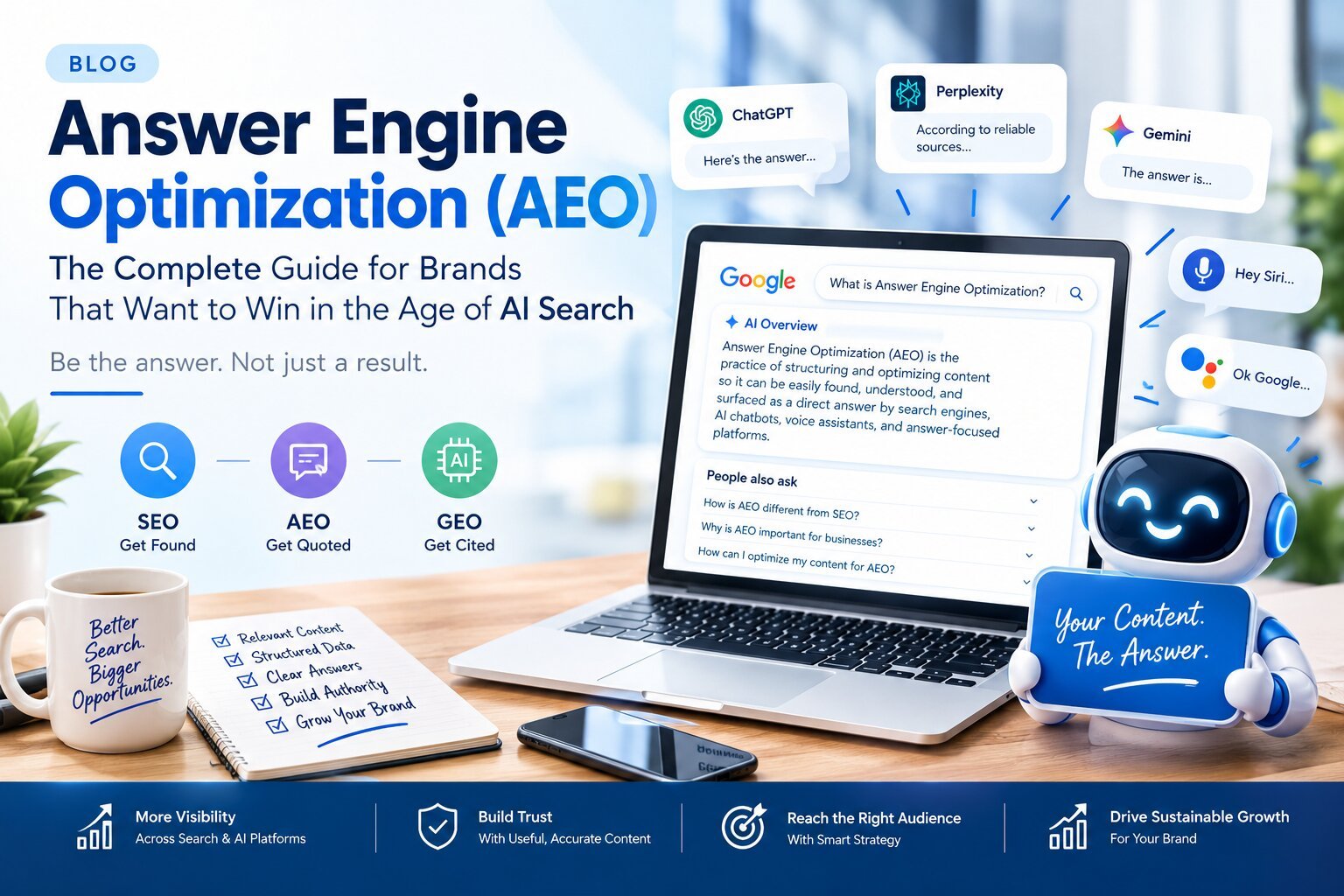
Type a question into Google today, and there's a good chance you'll never click a single blue link. You'll get your answer right there, in a snippet, an AI Overview, or a conversational response from ChatGPT, Perplexity, or Gemini. The search results page isn't just a list of links anymore. It's an answer.
This shift has a name: Answer Engine Optimization (AEO). And if your content strategy is still built entirely around ranking on page one, you're optimizing for a search experience that's quietly becoming yesterday's news.
In this guide, we'll break down what AEO actually is, how it's different from (and connected to) traditional SEO and the newer concept of GEO, why it matters for your brand's visibility, and how you can start optimizing for it today, practically, not theoretically.
What Is Answer Engine Optimization (AEO)?
Answer Engine Optimization is the practice of structuring and optimizing content so that it can be easily found, understood, and surfaced as a direct answer by search engines, AI chatbots, voice assistants, and answer-focused platforms.
Instead of just aiming for a top-10 ranking, AEO aims for a specific, high-value spot: the answer itself. That could be:
The core idea behind AEO is simple: make it effortless for a machine to extract a clear, accurate answer from your content and make that answer good enough that the machine wants to attribute it to you.
Why AEO Exists: The Shift From "10 Blue Links" to "One Good Answer"
Search behavior has fundamentally changed. People aren't just typing keywords anymore; they're asking full questions, the way they'd ask a knowledgeable friend. "What's the best CRM for a small e-commerce business?" isn't a keyword; it's a conversation starter.
Answer engines are built to respond to that conversational intent directly. And they pull their answers from content that is:
If your content checks these boxes, you become a source an answer engine wants to cite. If it doesn't, you become invisible even if you rank on page one.
AEO vs. SEO vs. GEO: What's the Difference?
This is where a lot of confusion comes in, so let's clear it up. These three disciplines overlap heavily, but they're not identical, and understanding the distinction will shape how you build your content strategy.
| Aspect | SEO (Search Engine Optimization) | AEO (Answer Engine Optimization) | GEO (Generative Engine Optimization) |
|---|---|---|---|
| Primary Goal | Rank higher in traditional search results | Get featured as a direct answer (snippet, voice, PAA) | Get cited or referenced inside AI-generated responses |
| Target Platforms | Google, Bing organic search results | Google featured snippets, voice assistants, PAA boxes | ChatGPT, Perplexity, Gemini, AI Overviews, Copilot |
| Content Style | Keyword-optimized, link-building focused | Direct, structured, question-and-answer format | Authoritative, well-sourced, easily "chunkable" content |
| Success Metric | Rankings, organic traffic, backlinks | Snippet ownership, voice search visibility | Citation frequency in AI answers, brand mentions |
| Content Format | Long-form articles, landing pages | FAQs, how-tos, definitions, lists | In-depth, fact-rich, well-structured authoritative content |
| Technical Focus | Meta tags, site speed, backlinks, keyword density | Schema markup, structured headings, concise answers | Semantic clarity, entity relationships, structured data |
The good news? These three disciplines aren't competing; they're complementary. Strong SEO fundamentals (site authority, technical health, backlinks) make AEO and GEO easier to achieve. And optimizing for AEO often improves your GEO visibility too, since both reward clear, well-structured, trustworthy content.
Think of it this way: SEO gets you found. AEO gets you quoted. GEO gets you cited by AI. A modern content strategy needs all three working together.
Why AEO Matters Right Now
A few years ago, this might have felt like a "nice to have." Not anymore. Here's why AEO deserves a seat at the strategy table this year:
1. Zero-Click Searches Are the New Normal
A significant share of Google searches now end without a single click to any website; the user gets their answer directly on the results page. If you're not the source of that answer, you're not getting the visibility, the brand impression, or the potential traffic.
2. AI Chatbots Are Becoming Search Engines
Millions of people now ask ChatGPT, Perplexity, and Gemini questions they used to Google. These tools synthesize answers from web content, and they cite (or paraphrase) sources they trust. If your content isn't structured to be understood and trusted by these models, you're excluded from an entire, fast-growing channel of discovery.
3. Voice Search Keeps Growing
Smart speakers and voice assistants don't read out ten results; they read out one. Winning that one spot requires content built for direct, conversational answers.
4. Trust and Authority Are More Important Than Ever
Answer engines are cautious about what they surface. They favor content that demonstrates real Experience, Expertise, Authoritativeness, and Trustworthiness (E-E-A-T). This rewards brands that invest in genuinely helpful, well-researched content, not just keyword-stuffed pages.
How Answer Engines Choose What to Feature
Understanding the "why" behind AEO selection helps you optimize more precisely. While each platform has its own algorithm, most answer engines look for similar signals:
Content Clarity
Is the answer to the implied question stated clearly, early, and in plain language? Answer engines don't want to dig; they want the answer handed to them.
Structural Signals
Are headings, subheadings, bullet points, numbered lists, and tables used to organize information logically? Well-structured content is easier for machines to parse and extract.
Semantic Relevance
Does the content clearly address the topic's core entities and related concepts, not just a single keyword? Modern engines understand context and meaning, not just exact-match phrases.
Authority Signals
Does the source have topical authority backlinks, mentions, author credentials, and consistent coverage of the subject? Trust is earned over time.
Structured Data (Schema Markup)
Does the page use schema (FAQ schema, HowTo schema, Article schema) to explicitly tell search engines what the content means and how it's organized?
Freshness and Accuracy
Is the information current, fact-checked, and free from outdated claims? Answer engines are increasingly cautious about surfacing stale or inaccurate content.
Practical AEO Strategies You Can Implement Today
Let's move from theory to action. Here's how to actually optimize your content for answer engines.
1. Answer the Question in the First 1–2 Sentences
Don't bury your answer under three paragraphs of introduction. If someone asks "What is AEO?", your content should answer that within the first couple of sentences clearly and directly before expanding with detail and context.
Example:
Question: What is Local SEO?
Weak opening: "In today's digital landscape, businesses face many challenges when trying to be visible online, and one important consideration is..."
AEO-friendly opening: "Local SEO is the practice of optimizing your online presence so your business appears in local search results, like 'coffee shop near me' or Google Maps listings."
2. Structure Content Around Real Questions
Use your H2s and H3s as actual questions people ask, mirroring natural search queries and voice search phrasing. This aligns your content with "People Also Ask" boxes and conversational AI queries.
3. Use FAQ Schema and HowTo Schema
Structured data doesn't change what your visitors see, but it tells search engines exactly what your content means. FAQ schema in particular is one of the most direct ways to signal "this is a question-and-answer format" to Google and other crawlers.
4. Write in a Conversational, Natural Tone
Answer engines increasingly favor content that mirrors how people actually speak and ask questions, rather than stiff, keyword-stuffed copy. Write like you're explaining something to a smart colleague: clear, direct, human.
5. Break Down Complex Ideas With Lists and Tables
Comparison tables, numbered steps, and bullet points aren't just good for readability; they're easier for AI models to extract and summarize accurately.
6. Build Topical Authority, Not Just Individual Pages
One great blog post won't get you cited consistently. Answer engines favor sources that demonstrate depth across a topic: a cluster of interlinked, authoritative content that covers a subject from multiple angles.
7. Keep Content Fresh
Update statistics, examples, and references regularly. Outdated content erodes trust signals, both for human readers and for AI models trained to prioritize current, accurate information.
8. Optimize for Featured Snippet Formats
Snippets typically appear in three formats: paragraph, list, or table. Identify which format fits your target question and structure your content accordingly. A "how to" question suits a numbered list; a "what is" question suits a concise paragraph definition.
Real-World Example: Turning a Blog Post Into an AEO Asset
Let's say Growholic publishes a blog titled "How to Improve Local SEO for Small Businesses." Here's how it would look before and after an AEO-focused revision:
Before AEO optimization: A 2,000-word article that opens with a long story about the importance of digital marketing, buries the actual local SEO tips in paragraph six, and has no headings that reflect actual search queries.
After AEO optimization:
The content itself might not even need to grow much longer; it just needs to be restructured to make the answers easy to find, extract, and trust.
Key Takeaways
About Growholic Corporation
Growholic Corporation is a results-driven digital marketing company in Nashik dedicated to helping businesses build a strong online presence and achieve sustainable growth. We combine strategy, creativity, and technology to deliver customized solutions in SEO, Local SEO, Google Business Profile optimization, website development, branding, social media marketing, performance marketing, content marketing, and AI-driven digital strategies, enabling businesses to increase visibility, generate quality leads, and drive long-term growth.
How Growholic Can Help
At Growholic Corporation, we don't just improve your online visibility; we build a complete digital growth ecosystem. From optimizing your website for search engines and AI-powered platforms to generating qualified leads through SEO, AEO, GEO, Google Business Profile, paid advertising, and high-quality content, our team helps businesses attract the right audience, increase conversions, and achieve measurable business growth.
Ready to make sure your brand is the answer, not just a result? Get in touch with Growholic Corporation today for a free content and search visibility audit, and let's build a strategy that keeps you visible across Google, AI chatbots, and everywhere your customers are asking questions.
Frequently Asked Question
1. Is AEO replacing SEO?
No. AEO builds on top of strong SEO fundamentals. You still need technical health, backlinks, and site authority. AEO simply adds a layer focused on structuring that content to win featured answers and AI citations.
2. Does AEO require a completely different content strategy?
Not necessarily. Many brands can adapt existing content by restructuring it around clear questions, adding schema markup, and tightening up direct answers rather than starting from scratch.
3. How long does it take to see AEO results?
It varies. Featured snippets can sometimes shift within weeks of optimization, while building the topical authority that supports consistent AI citations is a longer-term investment, often several months.
4. Do I need schema markup for AEO to work?
Schema isn't strictly mandatory, but it significantly improves your chances. It gives search engines explicit signals about your content's structure and intent, making it easier to feature.
5. Is AEO only relevant for large websites?
Not at all. Small and mid-sized businesses often see strong results with AEO because they can move quickly, target specific niche questions, and build topical authority in a focused area faster than larger competitors.
Conclusion
Search is no longer just about being found; it's about being the answer. Answer Engine Optimization represents a genuine shift in how visibility works online, driven by AI Overviews, voice assistants, and conversational chatbots that are reshaping user expectations. Brands that adapt their content strategy now structuring for clarity, answering questions directly, and building real topical authority will be the ones showing up when it matters most.
This isn't about abandoning SEO. It's about evolving it. The brands that treat AEO, SEO, and GEO as one connected strategy, rather than separate silos, will have the strongest, most durable visibility in the years ahead.