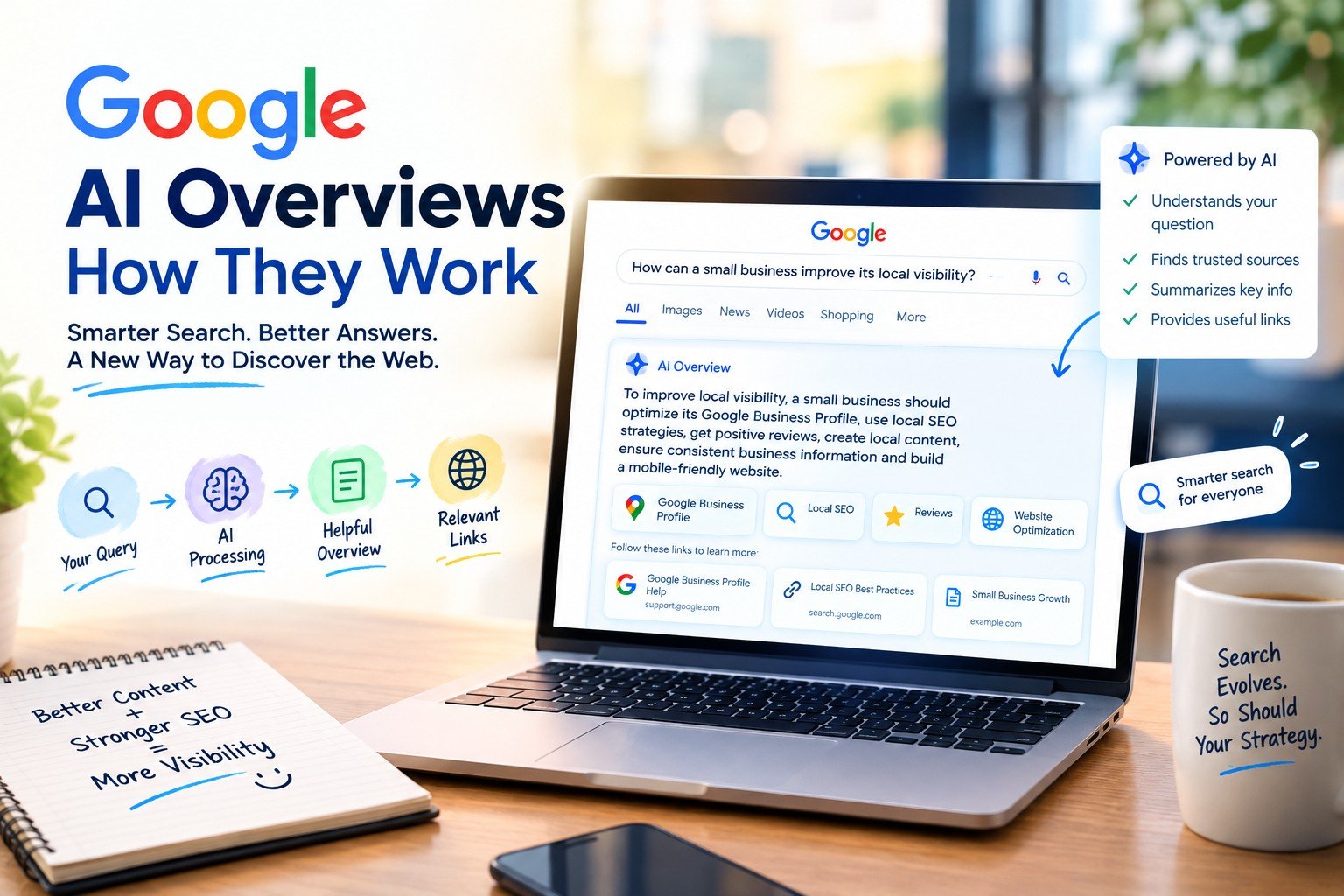
Google Search is no longer limited to a page of blue links. When you ask a question, Google may now show an AI Overview at the top of the results, summarizing information from multiple web sources and linking to sources so you can explore the topic further.
For businesses, this changes how online visibility works. Ranking in traditional search results still matters, but brands also need content that Google can understand, trust, summarize, and connect with relevant searches. This guide explains how Google AI Overviews work, what information they use, how they differ from traditional search results, whether SEO still matters, and what businesses can practically do to improve their chances of being discovered in AI-powered search.
Important: AI Overviews are generated by AI and can make mistakes. Google itself says users should continue to verify information, particularly for important decisions.
What Is a Google AI Overview?
A Google AI Overview is an AI-generated summary that can appear within Google Search when Google's systems determine that an AI-generated response can be useful for the query.
Instead of requiring the user to open several websites and combine the information themselves, Google can provide a summarized response with links to relevant web pages.
For example, someone might search:
"How can a small business improve its local visibility?"
Instead of seeing only traditional search listings, Google may provide an AI-generated explanation covering areas such as:
The user can then follow the supporting links to investigate individual sources.
Google describes AI Overviews as being connected to its core Search systems rather than functioning simply as an independent chatbot. The system uses Google's search and ranking capabilities to identify relevant information from the web and provide supporting links.
How Does Google AI Overview Actually Work?
The exact internal algorithms Google uses are proprietary, so nobody outside Google can provide a complete technical formula for how a particular website gets selected. However, Google's own explanations, published on the Google Search Central Blog, provide a useful picture of the process.
1. Google Understands the Search Query
First, Google tries to understand what the user actually wants. Consider these two searches: "SEO" and "How can I improve SEO for my local business?" They have very different search intent.
The second query contains a specific problem and expected outcome. AI-powered Search is designed to understand more complex and conversational questions, not simply match individual keywords. Google has reported that people using its newer AI Search experiences are asking longer and more complex questions.
2. Google Searches Its Information Systems and the Web
AI Overviews aren't simply created by asking an AI model to "write an answer." Google has explained that AI Overviews are integrated with its core Search ranking systems and are designed to identify relevant, high-quality information from its index.
This distinction is extremely important for businesses. Your website doesn't become visible simply because AI understands your topic. Your content still needs to be discoverable, relevant, useful, and trustworthy within Google's broader Search ecosystem — the same foundations covered in our SEO services.
3. Google Identifies Relevant Information
For complicated questions, Google may need information from multiple pages and sources. Google's newer AI Search systems use a technique called query fan-out in AI Mode, where a larger question can be broken into multiple related searches across different subtopics. Google says this allows Search to explore more information and find relevant content from different sources.
For example, imagine someone searches:
"What should I consider before opening a digital marketing agency in Nashik?"
A complex search could involve multiple areas such as:
The broader AI Search ecosystem can investigate different aspects before presenting information to the user.
4. AI Builds an Understandable Response
Once relevant information has been identified, Google's AI systems can organize and summarize it into a response. This is where AI Overviews differ from traditional search results.
Traditional Search might provide:
Website A → Website B → Website C → Website D
An AI Overview can instead provide:
Question → summarized explanation → supporting links
Google's goal is to help users understand a topic quickly while still giving them opportunities to explore the underlying web sources.
5. Google Provides Links to Supporting Websites
One of the most important aspects for publishers and businesses is that AI Overviews can include links to websites. Google has repeatedly emphasized connecting users with the broader web through AI Search, as outlined on The Keyword, Google's official blog. It has also introduced additional ways for users to discover and explore relevant websites from AI-generated responses.
This means AI Overviews aren't necessarily the end of website traffic. They can become another discovery layer between a user's question and your website.
Does Google AI Overview Use Only One Website?
No. An AI Overview can synthesize information from multiple relevant sources. This means your website doesn't necessarily need to be the only source discussing a subject. However, your content needs to provide something useful enough for Google's systems to understand and potentially use as part of the search experience.
This is why creating comprehensive, well-organized content around your industry can be valuable, an approach we cover in more depth in our guide to Answer Engine Optimization (AEO).
What Makes Content Easier for Google to Understand?
There is no official "AI Overview checklist" that guarantees inclusion. However, several practices make content clearer for both users and search systems.
1. Answer Questions Directly
If your heading asks "What is Local SEO?", don't spend five paragraphs introducing digital marketing. Give the definition immediately. Then explain it in greater detail.
2. Use Clear Headings
Organize your content with meaningful headings such as:
Clear structure makes long content easier for people and machines to understand.
3. Cover Related Questions
A strong article shouldn't answer only one keyword. It should address the natural questions someone has before, during, and after reading the main topic.
4. Use Accurate Information
AI-generated search results depend on information available across the web. If your website contains outdated, exaggerated, or unsupported claims, it can weaken the usefulness of your content. Google has emphasized quality and factuality in its AI Search systems.
5. Build Genuine Authority
One article rarely establishes expertise by itself. A website covering a subject consistently through useful guides, FAQs, case studies, service pages, and supporting content can create a much stronger topical presence.
Does SEO Still Matter After Google AI Overviews?
Yes. AI Overviews do not make traditional SEO irrelevant. Google has explicitly described AI Overviews as being integrated with its core Search systems. This means businesses should not abandon:
Instead, SEO needs to evolve alongside the changing search experience.
A useful way to think about it is:
Traditional SEO helps Google discover and understand your website.
Helpful content gives Google something valuable to understand.
AI Search creates additional ways for users to discover that information.
Can a Small Business Appear in Google AI Overviews?
Potentially, yes, but there is no guaranteed method for getting selected. AI Overviews are generated dynamically, and the sources shown can vary according to the query.
For a local business, the foundation should include:
The goal shouldn't be to manipulate AI systems. The goal should be to become a genuinely useful source of information for the questions your potential customers ask.
How Should Businesses Optimize Content for AI Overviews?
Here is a practical approach.
Step 1: Identify Customer Questions
Don't begin with only keywords. Ask: What does my customer actually want to know?
For a dentist, that could be: "How often should I get a dental cleaning?"
For a jewellery business: "How can I identify 925 silver jewellery?"
For a marketing agency: "How much does digital marketing cost for a small business?"
These questions can become content opportunities.
Step 2: Give a Direct Answer
Answer the question immediately. Then provide supporting explanations, examples and details.
Step 3: Create Complete Topic Coverage
Instead of creating 20 unrelated articles, build connected content around your important business topics, much like the topical clusters we recommend in our content marketing strategies.
Step 4: Add FAQs
FAQs help answer the smaller questions users naturally have. They also make your content easier to scan.
Step 5: Keep Information Updated
Industries, platforms, regulations, products, and technologies change. Review important content regularly and update information when necessary.
Step 6: Connect Your Content
Use relevant internal links between:
This helps users and search systems understand the relationship between your content, and it reinforces the practices we outline in our Generative Engine Optimization (GEO) guide.
What Is the Difference Between AI Overviews and AI Mode?
They are related but not identical. AI Overviews appear within the traditional Google Search experience for queries where Google determines an AI-generated summary can help.
AI Mode is a more conversational Search experience designed for complex questions and follow-up exploration. Google says AI Mode can use query fan-out to break complex questions into multiple searches and explore different subtopics.
In other words, AI Overviews are an AI-powered layer within Search, while AI Mode provides a deeper conversational search experience.
What Does This Mean for Local Businesses in Nashik?
For businesses in Nashik, AI-powered Search creates another reason to invest in local visibility and useful content. A business should not create content simply because it wants to rank for "best [service] in Nashik." It should also answer the questions customers ask before choosing that service.
For example:
This approach creates content that can serve customers at different stages of their buying journey.
How Growholic Approaches AI Search Visibility
At Growholic Corporation, we focus on building useful search visibility rather than simply filling pages with keywords. As an SEO agency in Nashik, our approach combines search intent, local visibility, helpful content, website optimization, Google Business Profile management and structured content to help businesses become easier to discover and understand across modern search experiences.
AI Search is changing, but the fundamental principle remains simple: businesses need to provide information that genuinely helps people. As a digital marketing agency in Nashik, Growholic Corporation helps businesses combine SEO, content, social media, Google Business Profile, paid campaigns, branding and other marketing activities into a connected growth strategy rather than treating every channel separately.
Key Takeaways
Frequently Asked Question
1. Does AI Overview replace Google's normal search results?
No. AI Overviews are an additional search experience. Traditional organic results continue to exist and remain an important part of Google Search.
2. Can I pay Google to get my website into an AI Overview?
There is no standard advertising option that guarantees organic inclusion in an AI Overview. Paid advertising and organic AI-generated results are different systems.
3. Can SEO guarantee an AI Overview appearance?
No. There is no guaranteed ranking position or AI Overview placement. Search results and AI-generated responses can change depending on the query and Google's systems.
4. Does Google AI Overview use ChatGPT?
No. Google AI Overviews are part of Google Search and use Google's own AI and Search systems. Google has described its AI Search experiences as being powered by Gemini models integrated with Search.
5. Can AI Overviews make mistakes?
Yes. Google states that generative AI can make mistakes and continues to improve the accuracy of AI Overviews. Users should verify important information.
6. Should businesses stop writing blogs because Google gives answers directly?
No. Useful websites can still be discovered through links in AI Search experiences, traditional organic results and other discovery channels. Google has stated that AI Overviews are designed to help users explore the web and connect with relevant websites.
7. What is the most important thing a business can do for AI Search?
Create accurate, genuinely useful, well-structured content that directly answers the questions your customers ask. There is no single trick that guarantees AI Overview visibility.
Conclusion: Google Search Is Changing, But Helpful Content Still Matters
Google AI Overviews represent an important change in how people discover information online. Instead of always visiting several websites and comparing information themselves, users can increasingly receive an AI-generated summary directly within Search, with links that allow them to explore the sources behind the response.
For businesses, the answer isn't to chase every new AI feature or fill websites with artificial content. The stronger long-term approach is to build a website that clearly explains what you do, answers real customer questions, demonstrates genuine expertise, and keeps its information accurate and useful.
SEO is not disappearing. Search is evolving. Businesses that combine strong SEO foundations with helpful content, local visibility, clear website structure, and genuine authority will be better prepared for the changing way people search, discover brands, and make decisions online.
Ready to make sure your business is easy to discover across Google, AI Overviews, and everywhere your customers are asking questions? Get in touch with Growholic Corporation today for a free content and search visibility audit.