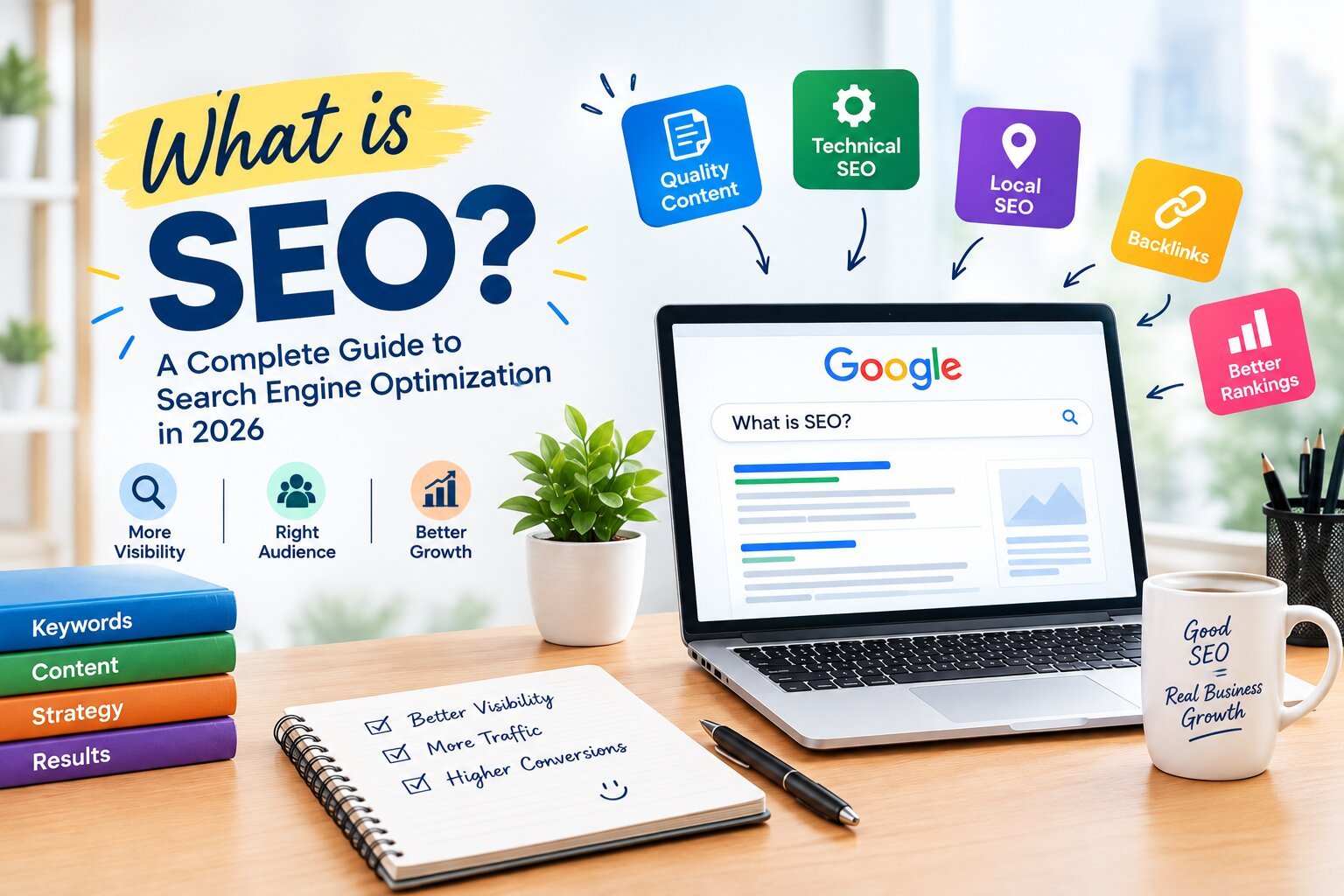
SEO (Search Engine Optimization) is the process of improving a website and its content so that search engines can better understand it and people can more easily find and use it.
But modern SEO is much more than adding keywords to a webpage. In 2026, effective SEO is about creating helpful, original, accurate, trustworthy, technically accessible, and people-first content while making the website easy for search engines to crawl, understand, and index. Google also states that its existing SEO fundamentals remain relevant for AI-powered experiences such as AI Overviews and AI Mode.
So, if you are asking "What is SEO?", the simplest answer is: SEO helps the right people discover your business through search by making your website useful for people and understandable to search engines.
Why Is SEO Important for a Business?
Imagine someone searches: "Digital marketing company near me" or "How can I grow my small business online?"
There may be hundreds of websites offering information or services related to that search. SEO helps your website communicate clearly about what you do, who you serve, where you operate, and what information you provide.
Good SEO can help a business:
However, SEO is not a guaranteed shortcut to the first position on Google. Google itself states that there are no secrets that automatically make a website rank first, and meeting SEO requirements does not guarantee that a page will be crawled, indexed, or served in search results.
How Does SEO Work?
Search engines need to discover webpages, understand their content, evaluate their relevance and quality, and then decide which results are useful for a particular search. A simple way to understand SEO is through three areas:
1. Crawling
Search engines discover pages and access their content. If important pages cannot be crawled properly, search engines may have difficulty discovering or processing them.
2. Indexing
After discovering a page, a search engine can process and store information about it in its index. Being indexed is important, but indexing does not guarantee high rankings.
3. Search Results
When someone searches for something, search systems determine which available results are relevant and useful for that query.
This is why SEO is not simply about putting a keyword on a page. The entire page — and often the wider website — needs to provide useful information and a good experience.
What Are the Main Parts of SEO?
Modern SEO can be divided into several connected areas.
1. On-Page SEO
On-page SEO focuses on the content and elements visible or relevant on your webpages. This includes:
Your content should clearly explain the topic instead of repeating keywords unnaturally. Google's current guidance emphasizes that its systems can understand how a page relates to different searches without requiring every possible keyword variation to appear word-for-word.
2. Technical SEO
Technical SEO focuses on whether search engines and users can properly access and use your website. Important areas include:
Technical SEO is not about making a website complicated. The goal is to create a clear, accessible, technically healthy website. Google's guidance for AI-powered search also says that pages need to meet the normal technical requirements for Google Search to be eligible as supporting links in AI Overviews or AI Mode.
3. Content SEO
Content remains one of the most important parts of SEO. But modern content marketing is moving away from simply producing large quantities of keyword-focused articles.
Good SEO content should:
Google's current guidance specifically emphasizes unique, valuable, non-commodity, people-first content for both traditional and generative search experiences.
4. Local SEO
If your business serves a specific city or area, local SEO becomes especially important. For example, a customer may search "digital marketing agency in Nashik" or "advertising agency near Pathardi Phata Nashik."
Local SEO helps search engines and customers understand your business's:
Keeping your business information accurate and consistent across your website and relevant business profiles is an important part of maintaining a strong local presence.
5. Off-Page SEO
Off-page SEO refers to signals and activities outside your own website that can help establish your site's reputation and visibility. These may include:
The focus should be on earning genuine recognition, not manipulating search rankings through artificial links. Buying links or creating links primarily to manipulate rankings can violate Google's spam policies.
Is Keyword Research Still Important in 2026?
Yes — but keyword stuffing is not. Keyword research helps you understand how people describe their problems, needs, products, and services when searching online.
For example, someone might search:
These searches reveal different types of user intent. The important modern approach is to understand what the person actually wants, then create a page that answers that need clearly. Google's systems are designed to understand language and relationships between concepts, so you do not need to force every possible keyword variation into an article.
What Is Search Intent?
Search intent means the reason behind a search. For example:
Understanding intent helps you create content that actually matches what the visitor needs.
SEO and AI Overviews: What Has Changed?
This is one of the biggest modern questions. Google now provides AI-powered experiences such as AI Overviews and AI Mode for eligible searches. But there is an important point: you do not need a completely separate "AI SEO" system to appear in these experiences.
Google says that the same foundational SEO practices remain relevant. Pages need to be crawlable, indexable, useful, and eligible for normal Search, and there are no special AI-only requirements or special schema needed to appear in AI Overviews or AI Mode.
Google's newer guidance also says that concepts often called AEO (Answer Engine Optimization) and GEO (Generative Engine Optimization) can be understood as workarounds for AI search visibility, but Google's own perspective is that optimizing for generative AI search is still fundamentally SEO.
So instead of chasing every new SEO trend, focus on: useful content + technical accessibility + genuine expertise + clear information + good user experience.
How to Make SEO Content More AI-Friendly
If you want your content to have a chance of being useful in AI-generated search experiences, structure it so that both people and search systems can understand it easily. A strong article should:
Google specifically recommends focusing on unique, valuable content rather than creating large numbers of pages simply to target variations of searches.
Does AI-Generated Content Hurt SEO?
Not simply because AI was used. The important question is whether the final content provides real value.
Google's guidance says generative AI can be useful for research and structuring content, but generating many pages without adding value can fall under its scaled content abuse policy. That means businesses should not publish hundreds of generic AI-written pages simply because they can.
Instead: research → verify → add genuine expertise → edit → improve → publish useful content. Human judgment and real business experience still matter.
What SEO Practices Should You Avoid?
Modern SEO is not about finding loopholes. Avoid:
Google's spam policies specifically address practices designed to manipulate Search or generative AI responses, including keyword stuffing, link spam, and scaled content abuse.
How Do You Measure SEO Success?
Ranking position is only one part of SEO. A business should also look at:
Google Search Console can help website owners understand their Search performance. Google has also introduced dedicated reporting for visibility from generative AI features such as AI Overviews and AI Mode, with the rollout reaching websites worldwide by August 31, 2026.
The real question should not simply be: "Did my ranking increase?" It should be: "Are we reaching the right people and helping them take the right next step?"
Growholic Corporation: Digital Marketing That Starts With Your Business
Growholic Corporation Pvt. Ltd. is a digital marketing agency in Nashik, located in Nashik City, Pathardi Gaon. Founded by Radhika Dhongade, an ambitious founder who is always thoughtful about her clients' businesses, Growholic focuses on understanding the business before planning its marketing. We provide 360° marketing services, covering both online and offline requirements, so businesses can build their presence, connect with customers, and grow with a practical marketing approach.
Growholic Corporation: Online + Offline Advertising Solutions
As an advertising agency in Nashik, Growholic Corporation helps businesses with both digital and traditional marketing requirements. Our 360° approach can include online marketing, social media, SEO, Google Ads, content, branding, and website-related services, along with suitable offline marketing solutions. Our goal is simple: understand the client's business, identify the right audience, and create marketing that communicates the business clearly and meaningfully.
Frequently Asked Questions About SEO
1. What is SEO in simple words?
SEO means improving your website so search engines can understand it and the right people can discover it through search.
2. Is SEO still important in 2026?
Yes. Google's current guidance says foundational SEO practices remain relevant for both traditional Search and generative AI experiences such as AI Overviews and AI Mode.
3. How long does SEO take?
There is no universal timeline. Results depend on factors such as competition, website history, content quality, technical condition, authority, search demand, and the changes being made.
4. Can SEO guarantee the #1 Google ranking?
No. There is no guaranteed method for securing the first position. Google explicitly states that following its best practices does not guarantee crawling, indexing, or serving.
5. Is keyword stuffing good for SEO?
No. Repeating keywords unnaturally can create a poor user experience and is specifically covered by Google's spam policies.
6. Is SEO only about Google?
No. SEO is a broader practice of making websites easier for search systems and users to discover and understand. However, Google's guidance is particularly important for businesses targeting Google Search.
7. What is local SEO?
Local SEO focuses on helping a business become more discoverable for searches connected to a specific location, such as a city, neighborhood, or service area.
8. What is AEO?
AEO commonly means Answer Engine Optimization. It refers to creating content that directly answers questions. Google notes that this and GEO are terms used in the industry, while its own guidance treats optimization for generative AI search as part of SEO.
9. What is GEO?
GEO commonly means Generative Engine Optimization, referring to efforts aimed at visibility in generative AI search experiences. Again, Google recommends focusing on its established SEO fundamentals rather than relying on special "GEO hacks."
10. Does FAQ content help SEO?
Useful FAQs can help visitors get direct answers and can make a page more useful. However, businesses should not create FAQs simply to target keywords. Also, as of 2026, Google no longer shows the FAQ rich-result feature in Search, so FAQ content should be created primarily for users rather than for a guaranteed special search-result appearance.
Conclusion: SEO Is About Being Useful, Not Just Being Visible
SEO has changed significantly, but its most important principle remains simple: create something genuinely useful for the people you want to reach.
Modern SEO is not about stuffing keywords into pages or searching for shortcuts to rankings. It is about building a website that is technically accessible, creating original and reliable content, understanding what users are looking for, demonstrating real expertise, maintaining accurate business information, and continuously improving the experience.
And as AI-powered search becomes a bigger part of how people discover information, these fundamentals become even more important.
Good SEO helps search engines understand your business. Great SEO helps customers understand why your business matters.