Retail Electronics · Case Study No. 02
By Growholic Corporation | Business Insights Series (Easy-to-Read Edition)
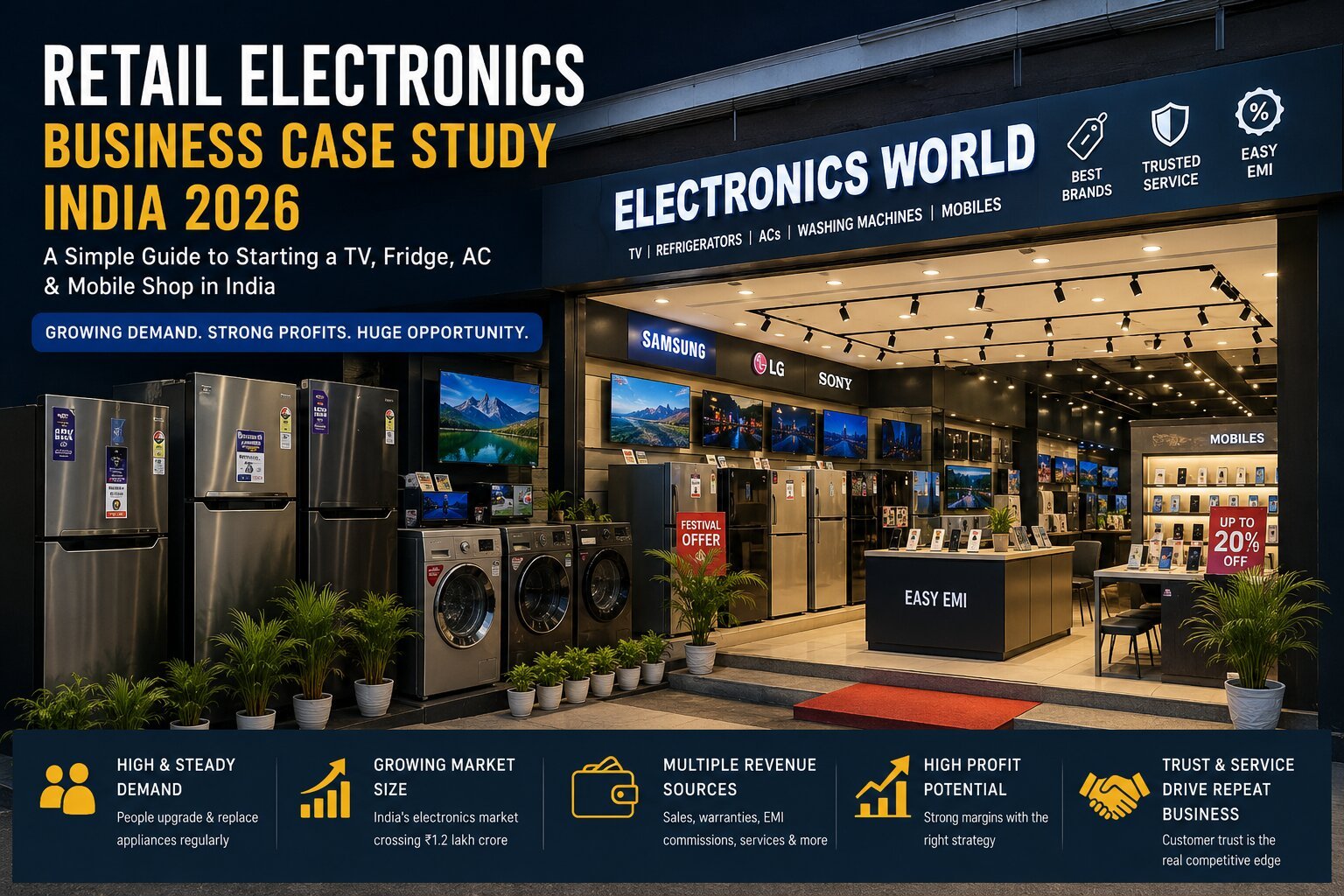
A Simple Guide to Starting a TV, Fridge, AC & Mobile Shop in India — Explained in Plain Language
1. Why This Business Is a Good Idea
In India, shops that sell TVs, fridges, ACs, washing machines, and mobile phones do very well, year after year. People buy these not for fashion but because the old one has stopped working or a new family needs one for the first time. This means people keep buying, no matter what is happening in the economy.
- Old appliances are breaking down: Millions of fridges and washing machines bought around 2015–2018 are now 8–11 years old and starting to fail.
- People want better products: Customers now want inverter ACs, frost-free fridges, and smart TVs — and are willing to spend more for these.
- Small towns still need shops: Big cities already have many branded electronics stores, but smaller towns still have very few. This is a big open opportunity.
Growholic Tip: This business is really about trust, not just products. People don’t buy a TV or fridge every month — so when they do, they want a shop they can trust for a genuine product, a fair EMI plan, and good service if something goes wrong.
2. Types of Shops You Can Open
| Type of Shop | Usual Size | Money Needed | Best For |
|---|
| Multi-Brand Store | 1,500–3,500 sq ft | ₹45L – ₹1.2Cr | Big cities and busy markets |
| Single-Brand Shop | 800–1,500 sq ft | ₹35L – ₹80L | Malls and brand-loyal shoppers |
| Small Neighbourhood Shop | 400–800 sq ft | ₹15L – ₹30L | Small towns and local markets |
| Franchise (Croma, Reliance Digital) | 2,000–5,000 sq ft | ₹80L – ₹2.5Cr | People who want big-brand support |
| Small Shop + Online Selling | 500–1,000 sq ft | ₹20L – ₹50L | Younger, tech-savvy shop owners |
Growholic Tip: If you join a big franchise chain, you earn slightly less profit per sale but get brand name, stock support, and marketing help — this often means you become profitable sooner (around month 8) compared to starting on your own (up to 18 months).
3. How Big Is This Market — 2026 Numbers
| What | Figure |
|---|
| Size of India’s electronics market | About ₹1.15–1.25 lakh crore every year |
| Share sold by branded/organised shops | About 42–45% (was only 32% in 2020) |
| Market growth rate per year | 9–11% per year |
| Fastest-growing products | Smart TVs and high-end ACs (14–16% per year) |
| How many people buy on EMI | 55–60% of total value in cities |
| Average bill per customer | ₹18,000–₹24,000 |
| Festive season share of yearly sales | 30–35% (Diwali, Onam, Independence Day) |
| GST on most appliances | 18% (large ACs and big TVs may be 28%) |
Growholic Tip: Almost one out of every three rupees this business earns in a year comes in just a 60-day window — mid-September to mid-November. Plan your stock, cash, and staff carefully around these two months.
4. Ways This Business Earns Money
- Selling Products: TVs, fridges, ACs, washing machines, mobile phones, and small appliances.
- Extended Warranty & AMC: About 8–15% of customers pay for longer warranty plans — very high profit.
- Commission from Banks/Finance Companies: When you help a customer get an EMI loan, the bank pays you 0.5–2% of the loan amount.
- Installation & Extra Items: TV wall-mounting, stabilizers, cables, and AC installation charges.
- Old Appliance Exchange: Trade-in programs where you resell or scrap the old item for extra profit.
- After-Sales Repairs: Charging for repairs after warranty ends (mainly for bigger shops).
- Bulk Orders: Selling in bulk to builders, hotels, and offices near new housing projects.
Growholic Tip: Warranty and service plans usually earn 35–45% profit, compared to only 8–14% on selling the product itself. A well-run shop should aim for at least 12% of total profit from warranty and financing alone.
5. How to Choose the Right Location
| What to Check | Why It Matters |
|---|
| Nearby footfall | Being near a supermarket or residential gate brings free walk-in customers |
| Income level of nearby families | Families should earn at least ₹35,000–50,000/month within 3 km |
| Shop front width and visibility | At least 20–25 feet of frontage; ground floor is best |
| Other electronics shops nearby | 1–2 competitors is good (shows demand); more than 4 means too crowded |
| Parking space | Very important — customers carry appliances home by car or auto |
| New housing projects nearby | New flats within 2 km is a strong sign of good demand in next 1–2 years |
Growholic Tip: The single biggest factor for good Year 1 sales is having a working ATM/bank nearby and enough parking. Customers often decide their loan or payment plan on the spot.
6. How Much Money You Need to Start
| What You Spend On | Small Shop | Medium Shop | Big Shop |
|---|
| Interior, flooring, signboard, lighting | ₹6L – ₹9L | ₹18L – ₹25L | ₹35L – ₹50L |
| First stock of products | ₹12L – ₹18L | ₹35L – ₹55L | ₹70L – ₹1.10Cr |
| Rent deposit (6–10 months) | ₹3L – ₹5L | ₹9L – ₹15L | ₹18L – ₹28L |
| Billing computer & software | ₹1L – ₹1.5L | ₹2L – ₹4L | ₹4L – ₹6L |
| AC, cameras, fire safety | ₹1.5L – ₹2.5L | ₹3L – ₹5L | ₹6L – ₹9L |
| Opening advertisement & marketing | ₹1L – ₹2L | ₹3L – ₹6L | ₹6L – ₹10L |
| Licenses, registrations, legal fees | ₹50K – ₹1L | ₹1L – ₹2L | ₹2L – ₹3L |
| Extra cash (3 months of costs) | ₹3L – ₹5L | ₹8L – ₹12L | ₹15L – ₹22L |
| Total Money Needed | ₹28L – ₹44L | ₹79L – ₹1.24Cr | ₹1.56Cr – ₹2.38Cr |
|---|
Growholic Tip: A good starting stock mix is roughly 45% on big appliances, 35% on TVs/mobiles, and 20% on small items — no matter how big your shop is.
7. Monthly Running Costs
| Fixed Cost | Monthly (₹) |
|---|
| Rent | 1,20,000 – 2,50,000 |
| Staff salaries (6–9 people) | 2,80,000 – 4,20,000 |
| Billing software and internet | 8,000 – 15,000 |
| Insurance | 10,000 – 18,000 |
| Other small office expenses | 20,000 – 35,000 |
| Total Fixed Costs | ₹4,38,000 – ₹7,38,000 |
|---|
| Variable Cost | Monthly (₹) |
|---|
| Electricity | 60,000 – 1,00,000 |
| Local advertising and promotions | 40,000 – 70,000 |
| Cleaning, repairs, small supplies | 15,000 – 25,000 |
| Total Variable Costs | ₹1,15,000 – ₹1,95,000 |
|---|
Total Monthly Running Cost: ₹5,53,000 – ₹9,33,000
Growholic Tip: Running 15–25 display units for 10–12 hours a day can make your electricity bill 30–40% higher than a clothing or grocery shop of the same size.
8. Staff You Will Need
| Role | How Many | Monthly Salary (₹) |
|---|
| Store Manager | 1 | 35,000 – 55,000 |
| Sales Staff (per category) | 4–5 | 18,000 – 28,000 each |
| Cashier/Billing Person | 1 | 15,000 – 20,000 |
| Delivery & Installation Coordinator | 1 | 16,000 – 22,000 |
| Cleaning Staff / Security Guard | 1–2 | 12,000 – 16,000 each |
Growholic Tip: Give your sales staff a small commission (0.5–1.5% of sale value) with a higher bonus for selling warranty plans.
9. Licenses and Registrations You Need
- Shop & Establishment Registration
- GST Registration
- Trade License (from local municipal office)
- Fire Safety Certificate
- BIS Compliance Papers (safety standards proof)
- Legal Metrology Registration (if selling pre-packaged accessories)
- Franchise Agreement Registration (if opening as franchise)
- Professional Tax Registration
- E-Waste Authorization (if running old-appliance exchange scheme)
Growholic Tip: As more shops now offer old-appliance exchange schemes, the government is checking e-waste paperwork more strictly. Make sure you have a written tie-up with an authorized recycler.
10. How to Price Your Products
- No-Cost EMI: Offer 0% interest monthly payment plans for purchases above ₹25,000.
- Bundling: Sell a washing machine with a stabilizer, or a TV with a soundbar, at a small combined discount.
- Exchange Bonus: Offer a little extra money when a customer trades in their old appliance.
- Festival Discounts: Save most of your discounts (8–15% off) for September–November festive season.
- Warranty Pricing: Price a 2-year extended warranty at about 6–8% of the product’s price.
Growholic Tip: Trying to match online shopping websites on price alone is usually a losing game. Win by offering faster installation, in-person demos, flexible EMI options, and reliable after-sales help. Promoting these deals through
social media marketing during festive season can multiply footfall significantly.
11. How Much Profit You Can Expect
| What | Small Shop | Medium Shop | Big Shop |
|---|
| Total Yearly Sales | ₹1 Crore | ₹2.4 Crore | ₹5.5 Crore |
| Gross Profit (~20%) | ₹20L | ₹48L | ₹1.10Cr |
| Real Profit in Year 1 | (₹7L) loss | (₹16L) loss | (₹15L) loss |
| Expected Profit in Year 2 | ₹8L – ₹12L | ₹22L – ₹32L | ₹55L – ₹75L |
| Profit as % of sales in Year 2 | 8–12% | 9–13% | 10–14% |
| Time to become profitable | 12–16 months | 14–20 months | 16–22 months |
| Yearly ROI | 22–33% | 22–32% | 28–38% |
Growholic Tip: Almost every electronics shop loses money in Year 1 — this is completely normal. What really matters is whether your profit reaches 9–10% of sales by Year 2.
12. Risks and How to Handle Them
| Risk | How to Handle It |
|---|
| TV and phone prices drop fast when new models launch | Keep only 3–4 weeks of stock for these fast-changing items |
| Online shopping websites selling cheaper | Compete on installation speed, demos, EMI, and service — not price |
| Running out of stock during festival season | Book your stock with suppliers by July–August |
| Theft of expensive items | Security cameras, insurance, keep costly phones behind the counter |
| Bank slow in approving loans | Work with at least 3 different finance companies |
| Money stuck in unsold premium stock | Ask suppliers for buy-back arrangements |
| Customers unhappy with after-sales service | Have a dedicated person to handle repairs and complaints quickly |
13. SWOT Analysis
- Strengths: People keep buying because old appliances stop working; high-value sales add up even on thin margins; many extra income sources through warranty, loans, and accessories.
- Weaknesses: Large amount of money tied up in stock; profit on hardware alone is thin; losing skilled sales staff directly hurts sales.
- Opportunities: Small towns still don’t have many branded electronics stores; more customers want premium products; warranty plans can become steady recurring income.
- Threats: Big online sale events where prices drop sharply; new technology making older models outdated quickly; government changes to GST rules.
14. Common Mistakes New Shop Owners Make
- Buying too many TVs and phones, not enough fridges, ACs, and washing machines.
- Not training staff to sell warranty and service plans.
- Not planning stock for the festive season early enough.
- Trying to match every online price, which shrinks already-thin profit.
- Not keeping enough spare cash in the first 6 months.
- Ignoring after-sales service.
- Choosing a location only because the rent is cheap.
15. Key Numbers to Track Every Month
| What to Track | Healthy Target |
|---|
| Profit margin on products sold | 18–22% |
| % of customers who buy warranty/service plans | 12–18% |
| Average bill amount per customer | ₹18,000–₹24,000 |
| Stock turnover per year | 6–8 times |
| % of shop visitors who actually buy | 25–35% |
| % of yearly sales during festival season | 30–35% |
| % of customers who return or refer | 20%+ within 2 years |
| % of sales paid through EMI/loans | 55%+ |
| Yearly ROI | 22–38%, depending on shop size |
The Simple Takeaway
Selling electronics is a solid business, but it needs real money upfront and careful day-to-day management. The shops that do well focus on trust and service, not just having lots of products on display. The products that build long-term profit are the steady ones — fridges, ACs, and washing machines — along with extra income from warranty plans, service contracts, and loan commissions.
If you start this business in 2026, expect to wait 12–22 months before making real profit. But if you pick the right location, sell the right mix of products, and train your staff well, you can expect 8–14% profit margins and a 22–38% yearly return by Year 2.
Published by Growholic Corporation | growholiccorporation.com
Disclaimer: All figures are indicative estimates for planning purposes only, based on general industry patterns across Indian cities in 2026. Actual costs, revenues, and timelines vary by city, location, execution quality, and market conditions. This is not financial, legal, or investment advice — consult a qualified professional before making business decisions.