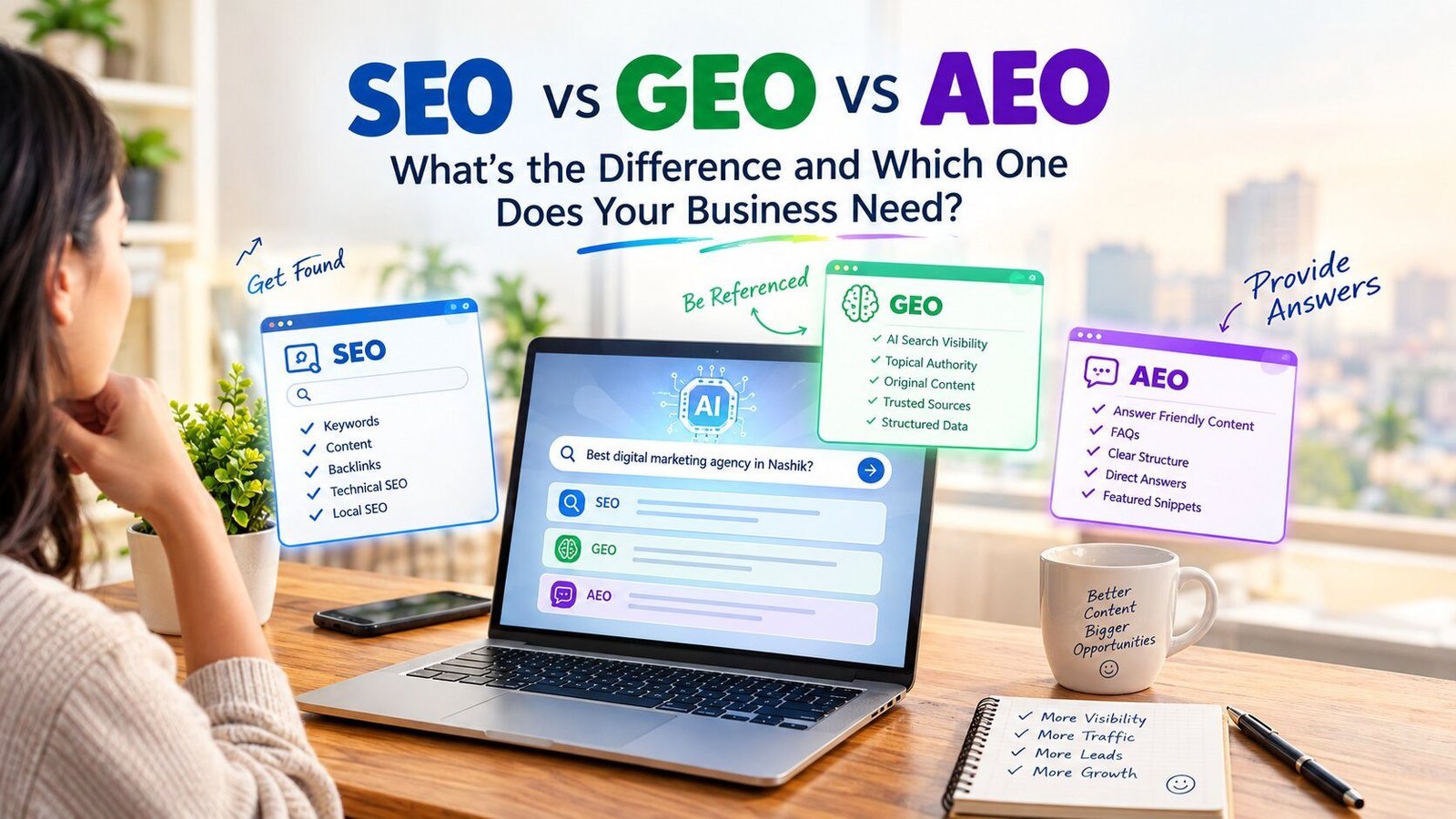
Search is changing. People no longer search for information only by typing short keywords into Google. They also ask complete questions, use conversational searches, and increasingly use AI-powered search experiences such as Google AI Overviews, AI Mode and ChatGPT Search.
This has introduced terms such as SEO, GEO and AEO. While these three approaches have different focuses, they are closely connected. Understanding the difference can help businesses create content that is useful not only for traditional search engines, but also for answer engines and generative AI platforms.
The important point is that GEO and AEO do not simply replace SEO. Google's current guidance says that established SEO practices remain relevant to its AI search experiences, because those experiences use information from Google Search and its underlying systems.
What Is SEO?
SEO stands for Search Engine Optimization.
SEO is the process of improving a website and its content so that search engines can better understand it and users can discover it through organic search.
For example, if someone searches:
SEO helps your website become more relevant and discoverable for these types of searches.
SEO includes several areas such as:
Google recommends creating useful, unique, reliable and people-first content rather than producing content simply to manipulate search rankings.
Simple example of SEO
Suppose you own a restaurant in Nashik. You may create a useful page explaining your menu, location, timings, services and frequently asked questions.
Someone searches "best family restaurants in Nashik".
Traditional SEO focuses on helping your website become discoverable and relevant for that search.
What Is AEO?
AEO stands for Answer Engine Optimization.
AEO focuses on making information easy for answer-oriented systems to understand and use when responding to a user's question.
Instead of thinking only about:
"What keyword should I rank for?"
AEO also asks:
"What question is my customer asking, and can my website provide a clear answer?"
For example:
Question: "What is SEO and how does it help a small business?"
A useful AEO-friendly page would provide a direct, understandable answer instead of forcing the visitor to read several paragraphs before finding the information.
AEO commonly involves:
The goal is not to write robotic answers. It is to organize genuinely useful information so that both people and search systems can understand it easily.
What Is GEO?
GEO stands for Generative Engine Optimization.
GEO is a newer term used for optimizing content for generative AI search experiences, where an AI system may gather information from multiple sources and generate a synthesized response.
The term was formalized in a 2023 research paper on Generative Engine Optimization. The researchers described GEO as a framework for improving the visibility of content within generative-engine responses.
Today, generative search can involve experiences such as AI-powered search results and conversational systems. For example, ChatGPT Search can search the web and provide answers with links to relevant sources.
GEO therefore places greater attention on things such as:
However, there is no guaranteed "GEO trick" that makes a website appear in every AI answer. Current research also shows that generative search visibility is an evolving area with significant variation between systems and queries.
SEO vs GEO vs AEO: What Is the Difference?
| Factor | SEO | AEO | GEO |
|---|---|---|---|
| Full Form | Search Engine Optimization | Answer Engine Optimization | Generative Engine Optimization |
| Main Focus | Organic search visibility | Getting information understood as answers | Visibility in generative AI responses |
| User Behavior | Searches keywords or phrases | Asks direct questions | Uses conversational or complex prompts |
| Main Platforms | Google, Bing and other search engines | Answer-focused search experiences | AI and generative search systems |
| Content Style | Comprehensive, useful and search-friendly | Direct, clear and question-focused | Factual, contextual and easy for AI systems to interpret |
| Important Elements | Technical SEO, content, links, local SEO | Questions, answers, FAQs, structure | Authority, original information, relevance, citations and accessibility |
| Main Goal | Help users discover your website | Help users find clear answers | Increase the possibility of being surfaced or referenced in AI-generated answers |
The boundaries are not absolute. A single well-written page can support SEO, AEO and GEO at the same time.
Do You Need SEO, GEO or AEO?
For most businesses, the answer is not to choose only one.
A better approach is to build a strong SEO foundation and make the content useful for questions and AI-driven search experiences as well.
Google specifically states that the foundational SEO practices used for traditional search remain relevant to AI features such as AI Overviews and AI Mode.
Think about it this way:
Together, they encourage businesses to create websites that are technically accessible, genuinely useful and easy to understand.
How to Create Content That Supports SEO, AEO and GEO
1. Start with real customer questions
Find out what your customers actually want to know.
For example:
Then create useful answers.
2. Write for people first
Do not repeatedly insert keywords just because you want to rank.
Google recommends people-first content that provides substantial value, originality and useful information.
3. Make information easy to understand
Use:
Good structure benefits both readers and search systems.
4. Show real experience
Generic information is everywhere.
Businesses can create stronger content by sharing:
This can make your content more useful and distinctive.
5. Keep business information consistent
For local businesses, make important information clear and consistent across the website and other legitimate online profiles.
This can include:
6. Maintain technical SEO
AI search does not eliminate the need for a technically accessible website. Google says pages need to be crawlable and eligible for normal Search in order to be eligible for supporting links in its AI features.
So continue working on:
Google also explains that structured data can help it understand the content and classification of a page.
Common Mistakes Businesses Should Avoid
Trying to optimize for AI search can lead businesses toward shortcuts that create poor content.
Avoid:
Google warns that generating large amounts of content without adding value can fall under its scaled content abuse policies.
The better strategy is simple: create something genuinely useful first, then optimize it properly.
What Does Growholic Corporation Do?
Growholic Corporation Pvt. Ltd. is a digital marketing agency in Nashik that works with businesses on online visibility, lead generation and brand growth. Founded in Nashik by Radhika Dhongade, the company provides services including SEO, local SEO, social media marketing, PPC, website development, branding, content marketing, reputation management and Google Business Profile management. Growholic also works across online and offline marketing, with a focus on understanding the local Nashik market and creating strategies around individual business goals.
As an advertising agency in Nashik, Growholic Corporation also provides traditional advertising solutions alongside digital marketing. Its services include hoardings and billboards, banners, newspaper and magazine advertising, radio, TV advertising, pamphlet marketing and other offline promotional solutions. This combination allows businesses to consider digital and traditional channels together rather than treating them as completely separate marketing activities.
Frequently Asked Questions
1. Is GEO replacing SEO?
No. GEO is a newer term associated with visibility in generative AI experiences, but SEO remains an important foundation. Google explicitly says its AI search features continue to rely on core Search systems and SEO best practices.
2. Is AEO the same as SEO?
No. SEO has a broader focus on search visibility, while AEO emphasizes providing clear answers to user questions. However, the two approaches overlap significantly.
3. Does every website need GEO?
There is no universal requirement to implement a separate GEO strategy. Businesses can begin with strong technical SEO, useful content, clear answers and reliable information, then monitor how their content appears in emerging AI search experiences.
4. Can AI-generated content rank on Google?
AI assistance itself is not automatically a problem. Google focuses on whether content is helpful, original, reliable and created for people. Producing large amounts of low-value content primarily to manipulate search rankings can violate spam policies.
5. How can I make my website more suitable for AI search?
Create clear, factual, original and well-structured content. Make your website crawlable, explain your expertise, answer genuine customer questions and keep important information accurate and updated.
6. Can I guarantee that ChatGPT or Google AI will mention my business?
No. Search and AI systems use multiple signals, and inclusion or placement is not guaranteed. OpenAI says ChatGPT Search uses multiple factors to rank results and that placement is not guaranteed.
7. Should I create separate pages for SEO, AEO and GEO?
Not necessarily. One strong, comprehensive page can serve multiple purposes. Creating separate pages only to target slightly different versions of the same query can result in unnecessary or repetitive content.
Conclusion
SEO, AEO and GEO may sound like three completely different marketing strategies, but they are better understood as different perspectives on the changing search journey.
SEO helps your website become discoverable. AEO encourages you to answer real questions clearly. GEO considers how information may be discovered, interpreted and surfaced through generative AI experiences.
The most sustainable approach is not to chase every new acronym or search "hack." Build a technically accessible website, understand what your customers genuinely want to know, publish original and useful information, demonstrate real expertise, and keep your business information accurate.
As search continues to evolve, the businesses that focus on helping people first will have a stronger foundation for being discovered across traditional search, answer-based experiences and generative AI search. Google itself continues to emphasize this people-first approach across both traditional and AI-powered search.